Saturday, April 27, 2013

ALAMBRE RESORTERA Q & A Fun Facts

The Alambre Resortera Fun Facts Q & A


Hello again fellow blog reader, since the humble wire coathanger slingshot's rise to popularity, there have been many ideas thrown around and also misconceptions with regard to my own use of this style of slingshot and what is and isn't what I have said.
 
I hope those of you who have enjoyed making this alternative weapon will bare with me this simple Q & A as I feel it is necesarry to keep the facts straight about this humble poor man's weapon.
 
So without further red tape let's get on to the meat of this quick post that will clarify some facts about this style of slingshot and my use of it.
 
 
Q: Is the Alambre Resortera the only slingshot you have ever made and used?
 
A: No, for the last three decades I mainly used slingshots made from natural tree forks as that is the base of my slingshot traditions. Because I worked in the family Tree service business in Southern California I had the opportunity to try all types of trees for slingshot use.  
 
However, the Alambre slingshot is also part of those traditions and was introduced to me when I was in my pre teens, circa 11 or 12 years of age. During this time having been the naughty boy that I was my parents tried to curb my making slingshots by preventing me from harvesting forks from trees while working with father. During this time I knew some kids from Baja Mexico and when I told the kid about my dilema he told me the story of the slingshot forks made from braided wires. Added to this my grandfather told me his version and from there my personal exposure to such a slingshot in a slingshot stand in Yahualica Jalisco planted the seed of creativity. I am 38 years old right now and I started to explore the wire coathanger slingshots within 11 or 12 years of age but this style is not the only one I use.
 
 Q: Is the Alambre Resortera the only slingshot you use to hunt smallgame?
 
A: No, like in the first question and answer for the majority I used natural tree forks and one board cut that my great uncle a guitar maker helped me make in Juarez Mexico. As a pree teen and a teenager when I did use the alambre resortera I killed the odd pigeon with marbles and took plenty of invasive sparrows and starlings.
 
It was in the last two years that I decided as a personal challenge to myself to test the limits and full potential that is possible with a properly made wirecoathanger slingshot. When I accepted the personal challenge my first major accomplishment was the harvesting of a cottontail rabbit. From here the use of the simplistic wire coathanger slingshot as a hunting tool became a growing fascination, since this time other rabbits and jackrabbits and wild fowl have been harvested with the use of the alambre resortera. In between I have still hunted with natural forked slingshots.
 
As a side note; the first slingshot I ever used to hunt was a classic plastic fork resortera from the Mexican mercado armed with round solid elastic I was 6 and a half to seven years old at that time.
 
Q: Do you claim that the wire clothes hangers were the only alternative, that kids have in the poorest barrios of Mexico?
 
A: No, I was  told by a kid from Baja that this style was one used as an alternative never have I claimed that this was the only material available to poor slingshot makers. I believe this story was taken out of context when I gave one of my alambre resorteras to my amigo Gary Flatband Miller, he had said that where he grew up in the Metro area you could get in trouble for cutting trees and was why they also made wire wire hanger slingshots and he felt this was also the case with Mexican Alambre Slingshots.
 
I told Flatband on a note with my gift that is style was one used in the poorest barrios of Mexico and I hold true to this story, if you're that poor where will you get cutting tools or a hand saw to cut boards with?  So yes the Alambre resortera is one of the many alternatives that existed and exists for any poor slingshot maker. I know many men decades older than me who made these slingshots as well.
 
The tradition is not limited to only using wire hangers there are wires all around you and I have used similar scrap wire to the wire hangers to make resorteras as well. I even have a friend who made an alambre style slingshot from scrap barbed wire.
 
Q: In recent times there has been some bad mouthing of this style of slingshot from people who imagine themselves to be "slingshot designers". What is your take on these negative commentaries?
 
A: Different strokes for different folks, no one says you have do what I do or even try to imitate the style/tradition. There are as many positive endoresments of one's way as there are the opposite. Then again some of these people do this not out of hatred for the style but as a personal stab at the one who popularizes such a thing.
 
Here's a link to some positive commentaries on the Alambre Resortera back in 2011 when I presented one of my creations at the Rebel Slingshot Forum; note nothing bad was ever said during this period.
 
 
That's all I can think of for now and if you have any questions feel free to email me.
 
Happy Hunting
 
Nico


Saturday, February 23, 2013

Slingshot Projectile Velocity Demystified..


 Slingshot Projectile speed for hunting? Misconceptions and facts from work in the field.


In many places on the internet forums for slingshots hosted by slingshot enthusiasts and also in various searches one finds this common question asked by aspiring slingshot style hunters. How fast does my slingshot projectile have to travel for hunting smallgame? Although it is a very good question it is also a very misleading question, simply because it is a vague question one that all too often generates many answers.
 
 Sadly this question generates the opinions and advice of armchair hunters and theorists or the hobbyist non hunting slingshot enthusiasts who have seen one too many videos of a fellow shooting his slingshot projectiles through a chronograph and then calculating "foot pounds or joules" which is a system used in fire arm ballistics  and unrealated to the use slingshot projectiles.
 
 
Nothing wrong with a hobby right? Of course not, but hobbies and real world field results on the same subject are always different. Studying the potential kinetic force made possible by a rubber powered projectile is great.
 Knowing the projectile speeds a rubber powered slingshot  is generating for the harvesting of smallgame is even better than theory.
 
Before I go on to debunk some of the claims of slingshot projectile speeds advised by some of the armchair hunters and related people, I want you to ask yourself something.
 
Do you really need to know how fast your slingshot projectile travels? Does owning a chronograph guarantee that you will harvest smallgame by knowing how fast your projectile travels? After all when great grandfather and grandfather or father made their slingshots in the days of the red innertubes and chained rubberband bands and big rubberband days they did not own a digital chronograph. Yet they did take their share of smallgame with a slingshot, in reality the true question then is how and why does a slingshot kill?
 
I suggest a review of my blog post The Slingshot as a Projectile Weapon to help you understand the killing mechanism by which the slingshot functions, by knowing this you will understand that knowing projectile speed is more of an idle curiosity than a medium of information to guarantee a slingshot's capability of harvesting smallgame.

I have always known over the years even from times when I did not know what a "digital chronograph" was that I did not need to know how fast a slingshot had to be for the sake of hunting. Some of the means by which we tested our slingshots the soup can test are outlined in the link to my other post in this blog post here The Slingshot as a Projectile Weapon.

The old timers who used the old style slingshot elastics did not have these problems, this I think is the problem we face in our modern age with the information super highway the internet, too many ideas to stay focused on what one truly needs to know about any given subject. Life has become too lazy and non dependant on personal experience, nor is it common for people to visit the local library and do their own research a sad affair. Most of my early education was gained in the Los Angeles County Library system, we should all support our local libraries they are a fading treasure.

Exaggerated Projectile Velocity claims

Often when an aspiring slingshot style hunter visits one of the big forums about Slingshots they will visit their "hunting section" and ask the question what kind of elastic and what kind of weight/grains steel or lead ball projectile is effective for hunting.  The answers fall along these similar lines and believe me these are no exaggerations as I have seen these over estimated recommendations parroted many times. 

(FPS = feet per second)
44 cal lead ball at 250 minimum
36 cal lead ball at 300 fps
 7/16 steel ball bearing at 300 fps
1/2 inch steel at over 200 fps
.50 cal lead ball at 200 fps minimum

Aside from this these would be hunters or arm chair hunters as I like to call these people will also lecture you on things they know little about such as elastic pull weight. By the end of the arm chair hunter's lecture the poor aspiring slingshot style hunter leaves the session scratching his head and regretting even asking the advice of these moderators in these big forums.

Am I attacking these pseudo experts? Of course not, this blog is intended to share the truth and nothing more. Now let's see the mythbusting facts vs the above exaggerated claims.

Real world field proven slingshot projectile velocities with projectile weight, speed and game harvested.

Most of what follows are experiences my own and one is quoted from a friend of mine who is an avid grey squirrel hunter who uses flatbands with a short draw.

What is the basic lethal projectile speed required for hunting smallgame with a slingshot?

Note: When I say basic projectile speed this is not meant as an absolute requirement but a real world observation of what projectile speeds have been field proven to take smallgame.

100 MPH One hundred miles per hour in feet per second translates to  146.6 feet per second.

A .457 lead ball at 140 grains traveling 146 fps will kill a grey squirrel if it is struck in the vital area. I have a friend who hunts with flat bands and his style is different in that he has a very short draw and release and with this velocity he has been able to harvest a grey squirrel one of the toughest of smallgame to harvest with a slingshot. Ironically a 300 grain projectile traveling at 130 fps will do more damage than this smaller projectile. Heavier projectiles can deliver greater impact at a slower speed.

A 300 grain or 20 gram pebble/river stone or rock for that matter traveling at this same 100 MPH is lethal to game larger than even a grey squirrel as it's weight is greater we can expect a greater blunt force on impact. Most of my chronograph field documented results have been using the chained office rubberband elastics and to this I will share what I know to be fact.

Ok then let's break this down into a simple real world chart with some short examples. 

The following is broken down into categories based on types of projectiles I have personally used in the field to bring home some smallgame.


River rocks aka pebbles: A pebble weighing 18 to 22 grams traveling from 146 to 150 fps has been proven effective at taking rabbits and jackrabbits out to 20 + yards. In some instances with the either the errant shot or the animal's natural evasive movement where my shot hit the body either ribs or spine this speed and weight of projectile had enough blunt force to stop the creature and obvious a needed quick finish. In other instances the solid impact produced an instant kill. Even a pebble of this weight will still effectively kill smallgame with a mere speed of 138 fps. As noted a pebble of this weight traveling 100 MPH has a crippling impact.

Lead Balls .50 caliber or (.500): A .50 cal lead ball when cast from scrounged wheel weights weighs approximately 180 grains and when cast from pure lead weighs 188 grains. A .50 cal lead ball of either alloy traveling from 150 to 170 fps will kill smallgame up to large jackrabbits.

 Here's my explanation: 

Although I have limited experience in hunting with lead balls I will share some of my experiences in the field. At one time a personal friend donated for me a mixed bag of hand cast lead balls, among these were various .50 cal lead balls he cast from wheel weights. Having gave these the soup can test I felt they were adequate. At one time I decided to take these .50 cal lead balls on my hunts and designated these for shots past 25 yards since pebbles at that range have more drop and so if you miss the first shot will spook game. I had my opportunity in early 2012 when hunting an abandoned defunct railroad with my dog, I came accross a jackrabbit which from 50 yards away looked smaller than it really was. Having hunted all week with smaller targets in mind I was intending for a head shot and I moved off the gravel railroad and unto the grass and stalked to within 33 to 35 yards. 

The Desert Hare was catching the last rays of the afternoon sun at 40 degrees F so I took my first shot with my alambre resortera armed with chained #64 office rubberbands. The first lead ball sailed over it's head and I took a deep breath drew back as far as I could and let fly the second .50 cal lead ball. A half second later I could hear the impact of the .50 cal projectile as it hit the top of the jackrabbit's head with a loud "pop" similar to a baseball hit by a bat. That was the end the jackrabbit fell to never get up with just it's nerves twitching. The creature was massive and weighed within 8 to 10 lbs and far to big to fit in my usual game bags. The image of this large jackrabbit can be seen at my post
The Slingshot as a Projectile Weapon


How fast was the .50 cal lead ball traveling that took this large jackrabbit? 

I later tested the exact same #64 chained bands that I used on this hunt with my F-1 chronograph and the same batch of .50 cal lead balls. 

The lethal speed of this projectile was a mere 163 fps and no where near the speeds preached by the arm chair hunters out there. This is all fact and not theory this is the point of this blog post. So you see a mere 160 fps can carry enough energy past 100 feet to make such a significant smallgame kill.

I have also taken large pigeon with these .50 cal lead balls and same elastic and speeds with a crop shot which stopped the large pigeon in it's tracks.

But does using a faster slingshot projecting a .50 cal lead ball at 190 to 200 fps give you an advantage you ask? Simple answer.. No: My use of the red chained bands the High Quality #32 rubberbands in a 4x4x4 chain taught me this fact.

The High quality Red #32 rubberband chains in a 4x4x4 chain project the .50 cal lead ball from 193 to 200 fps and I have tried to use these faster rubberbands in similar field situations and found that the shots drop sooner or even curve in flight. Yes a perfect sphere can curve in flight and there is a YT vid of a prominent German shooter showing a "steel ball" curve in flight.

Although another topic all together, I will only say that the faster elastic with same projectile will work better or more accurate within the 20 yard max range but better in 10 to 15 yards. This has been my personal experience and to make these faster elastics perform better you would have to shoot a heavier projectile. This of course is another topic all together and I digress. 

Let's  move to the next most popularly advised slingshot projectile for smallgame hunting. 

Half inch steel ballbearings: To my metric inclined friends across the pond these are 12.7 mm steel balls or .50 cal steel  these 1/2 inch steel balls weigh 129.63 grains around the weight of a .44 cal lead ball cast in wheel weight alloy or slightly more. I believe the .445 lead ball cast in wheel weight alloy is 128 grains.  A half inch steel ball bearing traveling from 167 to 172 fps has enough force to take pigeons and their cousins in the squab family out to 30 yards on several occasions I have taken pigeons with head and neck shots out past 20 yards and the 12.7 mm steelie had enough force to take down the pigeons with a clean kill and crippling if not a perfect shot. One smaller member of the squab family I stopped at 30 yards with one of these half inch steel balls. Yes you can also kill rabbits with these steel balls, please only shoot for the head on rabbits and with pigeons the same head, neck shots for best results.

As you can see these projectile speeds are no where near the exaggerated velocities suggested by the arm chair hunters and their cousins the card & milk jug shooters.

These are just of the in the field results and the resulting chronograph tests I have taken after these smallgame kills. Why did I chronograph after the kills?
Simple I suspected that the projectile velocity was no where near as fast as some of the exaggerated claims seen on the forums out there and I was correct.

I hope this helps the new comer to hunting with a slingshot, to avoid further confusion and no you dont need to chrony your shots beforehand.

Just some food for thought and if you have an questions please feel free to ask.


Thursday, November 1, 2012

On The Antiquity and use of Chained Rubberband bands for slingshot use

How old is the use of chain linked rubberband bands for slingshot use?


It is said historically that the first patented rubberbands were credited to an Englishman by the name of Thomas Perry in 1845, from here begins the trail of our humble rubberband. However, as much as we must understand the history of rubber itself which goes further back to Mesoamerica whence Colombus first encountered it's use by the ancestors. We must now return to their history within the use of slingshots.
 
Some say that art imitates life and because of this so much of what we know about history has been traced through an artistic hand. I learned of this from my years as a student of Anthropology and the branch of Archaeology so too can time lines be traced within the paintings left behind by an artist's paint brush, an expression of time. 
 
 Enter Karl Witkowski, An American artist: this artist gentleman existed between 1860 to 1910 and was influenced by an older artist of the time J.G. Brown (1831 - 1913) like his mentor Karl's art focused on life at that time he made many paintings of the shoe shine boys and paper boys. As many should know it's the paper boys who had the most access to our humble rubberband ( I will elaborate on this aspect soon enough).
 
 
Karl Witkowski made a painting titled  The little hunter (circa 1860-1910) which depicts a boy crouched on the side of the tree with a slingshot in hand shooting upwards no doubt the boy is hunting birds.  If you pay close attention to the detail of the boy's slingshot you will see he is using chained rubberband bands on the slingshot in the painting.
 
A close inspection of the bands on this boy's slingshot reveals the indicative knots of a chain linked rubberband slingshot band.
 
 
As can be seen here in this single chained rubberband band. A careful examination reveals the same knots in the boy's slingshot bands that can be seen in this complete chain for slingshot use. When I was a kid in the 1980s my main source for these rubberbands for chaining in slingshot use came from the asforementioned paperboy. 
 
 It appears that history does repeat itself, as the boys in the artist Karl Witkowski's timeline were paper boys then they too used these rubberbands to make their chain linked rubberband banded slingshots.
 
The next time someone asks you how old fashioned the use of chained bands are in the use of slingshots, you can deffinately tell them that the chains have been in use for more than 150 years. Of which the chained rubberbands are still used to this day in many a successful hunt with a slingshot.
 
I dedicate this post to the artist Karl Witkowski who made it possible for us to have an idea as to the antiquity of chained rubberbands in slingshot use and history. 
 
Happy hunting
 
Nico


Tuesday, October 23, 2012

Being prepared: Hunting ammo

Being prepared with hunting ammo for your slingshot

Types of ammo for the hunt; a means to an end.


As most hunters have a prefered ammo, which sometimes is largely based on their equipment i.e. the chosen elastic for their slingshot. Sometimes a type of elastic will only work with heavy ammo, others only light ammo.
 
 
 For example, when I was about 18 years old we once found a black rubber tie down which was more elastic than the usual rubber tie downs maybe that batch of rubber was more stretchy, who knows? Haven't seen another like it but haven't searched too much either.


I asked my father if that rubber strip could make a good resorte (elastic band) he gave it a good stretch and suggested that if it were cut down the middle it might work? With that I helped him cut this rubber tie down, first we cut off the thicker molded ends. Then he started a cut on one end with his sharp buck knife, then I held these two pieces as he carefully cut the entire length till we ended up with two black square like bands. I took a strong fork and a thick leather pouch and built myself a resortera with these black cube like resortes.
 
On to the point of the example It was not as stretchy as either tubes or chains but the slingshot did work.  If you shot these heavy bands with a marble you saw no power and it was terribly slow, these heavy bands did however have a lot of muscle to shoot 1 once lead fishing weights with ease and heavy impact out to 50 yards no problem. 
 
This elastic was only effective with heavy ammo, some elastics can not handle heavy ammo and only do well with light ammo.
 
Other elastics like my favorite chained office rubberbands are more balanced in their tollerance of light and heavy ammo. Because of this it has given me options which through experience has shown to be the difference between coming home with a meal or coming home empty handed.


My two favorite hunting elasics are the high quality chained red #32 rubberbands in a 4x4x4 configuration per individual band, and my other are the economical ubiquitous chained #64 office rubberbands in a 3x3x3 chain per band.  Both kinds of chained elastic bands have proven efffective with ammo from baked clay balls to 1/2 inch steel balls up onto heavier steel balls and lead balls to 308 grain(20 gram) oval pebbles.

 Hunting terrain/area: Where you hunt has an effect on the kind of ammo you will use. I personally hunt within abandoned railroads, industrial areas with wild areas so this gives me a varying degree of terrain.  I am primarily a pebble user that is I personally prefer to use heavy pebbles for my slingshot hunting ammo but I have encountered terrain situations where the size of the pebbles were rendered ineffective for the situation at hand.


Hunting ammo for slingshots can be utilitary based on the situations a hunter will encounter.


What follows are a list of the kinds of hunting ammo I will carry within the possibility of what I might encounter in a given hunting situation. I will list their strengths and weaknesses.

 
Pebbles:    I normally carry oval or similar smooth pebbles (stones) that are within the 20 to 21 gram weight area. They have the most stopping power of my general ammo and are what I use for hunting rabbits, jackrabbits or squirrels and larger fowl and even pigeons and doves given the situations I encounter. Strengths, out in the open on the ground these pebbles are next to unstoppable the only thing that saves game is if the pebble misses it's mark these heavy pebbles can be used within light cover like small leaves on a small plant. Weakness these heavy pebbles can and do get deflected due to their larger size through heavy branch cover such as a branch pile, or heavy cover like blackberry vines or in trees with thick cover; these heavy pebbles can have a pin pall machine like effect in such instances. Despite their draw back in heavy cover, I can have taken all variety of smallgame with strictly using these pebbles.

Hexnuts: Are also a great general ammo that I will use when I am low on my supply of good hunting quality pebbles. They have similar impact but have their weaknesses in that because of their flat shape and the fact that they do occasionally spin they sometimes have a less solid impact. This is ok if you hit the main vitals solidly or have a solid hit. Another quirk is that because of this irregular shape they can deflect depending on your angle of impact. In this way pebbles are superior as you encounter less deflection with a heavy pebble.

If you're a target shooter reading this you might say "how can your shot not hit solid?".  Simple answer wild animals for one are hardly static targets nothing like the shape of a paper target or a soda pop can. Animals are living breathing targets that move a bit when you are stalking them and inviting them to be your honored guest at the dinner table; the angles you encounter in the field are hardly those you face while you're at the target shooting session making a video to show off your marksmanship. I will elaborate more on this topic in another post.

Ball bearings aka Steel balls:

I like to use steel balls in sizes from 1/2 inch to 13 mm to 14mm on to 16 mm, they are a good choice as a general hunting ammo. The half inch steel ball weighs approximately 129.6 grains just a fraction more than a .44 cal lead ball cast with "wheel weight alloy" which is lighter than pure lead.

With half inch steel balls and proper shot placement to vitals you can take game up to cottontail rabbit size. The half inch steel ball retains enough energy out to 20 yards to effectively dispacth a pigeon with a proper neck shot.

For longer shots with more knock down, I prefer 14 mm which is 11.25 grams or 173.6 grains this is about the weight of a .490 lead ball cast from a wheel weight alloy. The 14 mm steel is what I prefer for longer shots as it has more knock down power, my in between size is 13 mm which is 139 grains more like the weight of a .457 lead ball cast again from a wheel weight alloy.

I like the 1/2 inch steel for long shots on birds like pigeons in high places, this is good because, larger ammo if it passes over the bird will spook it. But a 1/2 inch steel ballbearing is not as alarming at least in my experience I have missed two shots and had a third try which resulted in bringing home some meat. In contrast I have taken these high shots with a pebble and when the much larger pebble passed over the bird's head it immediately flew away to safety.

These steel balls are also good for situations with heavy branches or heavily wooded zones. Such as shooting at a rabbit hidden in a black berry bramble or through fenced like material, or a dove in a conifer tree etc. It's smaller size will fit in such areas and deliver enough force to bring home your meal.

The caveat is the ricochete steel balls will bounce back with great force when they impact with large rocks or concrete and steel structures such as old over passes where pigeons may be hiding etc. In open ground and with non ricochete zones steel balls are perfect. Just make sure to adjust size for the situation/terrain you will hunt. In sum total  the steel ball is a great slingshot ammo especially if you dont want to cast lead balls. Steel balls and pebbles are my first choice for game around water as lead we all know is toxic and we have all contributed to the lead pollution in water from years of fishing at least I know I did.


Lead balls:

I am new to the use of  lead balls but in my short experience I have found lead balls to be as effective for smallgame hunting with a slingshot as some of my other favorite ammunition for slingshot use.  I realize my statement will seem redundant to those who primarily use lead balls as slingshot ammo.

 But I am a hunter who has used stones/pebbles as my main hunting ammunition with a slingshot for the better part of 30 years. For me then I must compare the effectiveness of lead balls to the knock down power I have known in the use of pebbles.  Lead balls deffinately get the job done but for my style of hunting I still find the heavier pebbles to be superior when it comes to knock down power.

However of all the things mentioned regarding steel ballbearings, you can have the same size lead balls with a lot more weight therefore more impact. Lead balls can deliver more punch than a steel ball of the same diameter. Consider that a 1/2 inch steel ball weighs only 8.4 grams or 129 grains a 1/2 inch lead ball due to lead's higher density weighs roughly 181 to 188 grains so you have a lot more punch.  In my limited lead ball use as my first lead balls were purchased later a friend (jmp) donated some lead balls.

 I find the .500 or 50 caliber lead ball to be an all around good round for hunting with my personal slingshots and my BT(blunt trauma) slingshot set-ups. It has the ability to carry it's weight out to past 30 yards and still deliver lethal impact and it's size will lend itself to tight spaces.  If you're not adverse to casting lead balls this can be a nice weekend project for you. Again you dont need lead balls to fill the pot with a slingshot this is well known but as my father once said to me "just because you don't have any good rocks available does'nt mean you are without ammo, look around you will find something" that's coming from a man who has at times used and reused a 7/16 socket as a slingshot projectile to take various feral jungle fowl and various cottontail rabbits!I say it is a good idea to have a lead ball mould as a backup. I will give further review to lead balls and different calibers on another post. I have yet to further explore this area. 

Moving along

Clay balls:
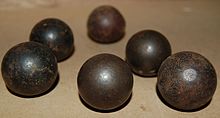
As in this picture a batch of clay balls I made and two completed in the center from a previous batch and fresh clay as you can see some of the moisture on the cardboard from the fresher clay balls I have air drying.


What I find most comical is that there are various "hunting experts" on the use of slingshots who say clay balls are not effective for smallgame hunting.
A word to the hunters out there who have made statements like "clay balls won't kill anything, you need big lead or steel etc":  

For the better part of many centuries baked clay balls have taken wild fowl and small mammals from prehistoric Mesoamerica to Medieval Europe, in ancient Mexico there are artifacts from Cholula which show fire hardend clay balls that were used in Blowguns to hunt birds for the purpose of eating. In fact in medieval Europe there are wood cuts and paintings that depict bow hunters on boats with a stone bow shooting water fowl with fire hardend clay balls to kill waterfowl such as ducks and other such waterfowl. The medieval bullet crossbow was used at first with oven hardend clay balls to shoot rooks out of the tree with a lamp. All proven history the fire hardend clay ball is effective on smallgame largely birds but some mammals.

Back to their use as a slingshot ammo for hunting: In my own history my very first rabbit came from the use of a large sunbaked clay rock in rural Mexico it was a close range shot but an instant kill. I have used oven baked clay balls to take various pigeons if you know anything about hunting pigeons you will know what tough birds they are. Some of my hunting colleagues have failed to take pigeons with heavy lead balls, so listen up hunters I have something to share here.

At ranges from 15 to 45 feet a well placed shot from a clay ball will bring down a full grown pigeon.  I have a friend from Coastal Mexico who informed me of his past resortera hunts who after hearing of my clay ball harvested pigeons shared with me how he used to make clay balls from the natural clay which he would add "rabbit pellets" to help make a denser ball something similar to making an adobe brick. The man said he took his share of doves and quail with these "bolas de barro" earthen clay balls. 

I always take these clay balls with me in areas where I fear damage to surrounding property or where I have danger to myself from ricochete or too much sound which can draw unwanted attention. They are eco friendly if you hunt waterfowl or frogs with clay balls. The standard 7/8 clay ball dry weighs 9 grams, that's more than a half inch steel ball!

The beauty is that they will shatter on impact to a very hard surface to a steel girder or concrete wall. Therefore safe for you with no ricochete and if they impact a pigeon's crop, neck or head you have a meal to take home. The only requirement is that you are keeping up with your accuracy.

Marbles "Canicas": We used to call marbles canicas as kids which is Mexican slang for glass toy marbles. Marbles have a similar history and use to clay balls, the average marble is pretty light about the weight of a 3/8 steel ball.

Can marbles kill? Yes of course they can, I have killed countless pigeons and invasive birds like Starlings with simple marbles in my childhood.  What I will say is that I learned in my childhood resortera days that with canicas if you hit a pigeon or dove in the body most times they flew away unharmed unless it was a very close shot and your canica "marble" happend to impact flush with the heart zone of a pigeon or dove then it would outright kill the bird.

But for me as a kid my shots I say were either lucky or an unconscious instinct directed my shots to the neck/head area because I did fell my share of squab with the underestimated marble. 

 But can marbles kill larger animals like "rabbits"? Yes they can and there are too many unique situations from both lucky individuals and some extraordinary slingshot marksmen who have killed more than a few rabbits with canicas.
My father killed some cottontails with marbles and so did my maternal Grandfather in the red innertube resortera period. I recently spoke to my father about hunting with "canicas" marbles. He said he had killed many rabbits with marbles but he also cautioned that you had to have a perfect head shot to kill a rabbit with a marble as anything less was a loss.

My recommendation as a responsible hunter is to use something more impactful like a 1/2 inch steel ball or preferably larger like 13 mm or 14mm. Or heavy oval pebbles or even hexnuts or lead. The majority of rabbits I have taken over the years have been with pebbles.

My personal responsible opinion is that marbles are good for bird hunting and I would not use a marble unless it was all I had left to shoot and it was my only chance to take a rabbit with a clean head shot. The same applies to my use of oven hardened clay balls.

But I digress and return to the canica, the marble has all the same uses for bird hunting that the clay ball does but it does have it's dangers as well, if a marble impacts concrete it may shatter and the glass shards can go in your eyes or it may not shatter and ricochete you just never know with a marble.


Putting it all together

Please note these are just my musings as this blog is almost like a living journal of the resortera style hunter they are the benefit of my experience only.

I always ask myself, what game am I looking for? Will there be shots of opportunity? Do I want to take the shots of opportunity? In such cases where there is more a need to bring meat, I am always keen to the shots of opportunity than the mere sporting aspect of simply persuing one quary in particular.  I consider the terrain first then I will consider my slingshot.

In general with my alambre resortera powered by chained #64s I know what projectiles I am able to use.  If it's a general hunting trip and I know where I am hunting I will arm myself accordingly.

If squab in concreted areas, I will use fire hardened clay balls but I will also carry my pebbles always as a standard ammo for sometimes squab can be found grazing in the field on seeds and or picking at gravel here the open range is perfect for either pebbles, ballbearings, or even hexnuts as an example. Always reserve the fire hardened clay balls for work in cave cliff terrean whether man made or natural where there is danger of ricochete. Again by having the clay balls and some pebbles I am already able to take most species.

What if you are hunting rabbits? Or jackrabbits during spring where the grass is tall. Here it's a good idea to have some options, steel balls or lead that can get in such places.

As an all around kit I will generally take 6 to 9 pebbles or hexnuts and 6 to 9 steel balls and 6 clay balls for my excursions. If I am out longer with more anticipated opportunity I will carry 10 to a dozen 1/2 inch steel ballbearings.

Hopefully some of this can be of some use to someone reading this and needs a loosely made blueprint of how to prepare for their hunt with a slingshot.

Good luck on your hunt


Friday, September 7, 2012

Why do I hunt with a Resortera/Slingshot?

Why do I hunt with a slingshot?

 
Personally I hunt with a slingshot simply because I was raised hunting with a slingshot. It is the first projectile weapon that was placed in my hands when I was only six and a half years old. I come from a family of slingshot hunters, my father and uncles hunted with a resortera as kids and so did their uncles and there the line continues. 
 
When I was six years old my maternal grandfather took us fishing in Seal Beach under a bridge, I saw my father take a walk off to some grassy area with his homemade resortera powered by surgical tubing and some pebbles/rocks and come back 30 minutes later with a nice sized cottontail rabbit he hit in the eye. I was forever moved by this event and saw the slingshot as an awesome weapon( we ate good that evening). Later I learned he had acquired the surgical tubing from our Family Dr. that donated to him from the stethoscope for always mowing the lawn at the DR's office.
 
As a kid at six and a half my father took us to rural Mexico to visit my grandparents and while in the pueblo "small village" while gathering provisions to go to the ranch we encountered a "resortera puesto" simply put a slingshot stand. Well I looked with curiosity and saw a curious looking plastic framed slingshot with round solid rubber tied down on the forks and tied to the leather pouch. Well my father bought this "first resortera" for me and he retied it so it would work well for me.
 
All father showed me was a quick demo of how to shoot it and after that I went on to explore with my first hunting weapon in the 3 month visit in rural Mexico.
At first I did not shoot well but as I kept at it I soon killed my first few birds and small frogs and lizards. Soon I was scolded by grandmother to never kill unless I intended to eat something so they cooked the small birds for me to eat.
 
But they did not want to cook the lizard (they said that kind was poisonus to eat) yet I was wiling to eat it as I had learned a new rule. You killed it, you eat it.
 
It was for me a very exciting experience but then you learn that this comes with responsobility.
 
By eight years old I started to build my own slingshots from forks collected from the various trees my father cut in his tree service. The journey has never stopped and will continue.
 
I am not trying to delve into history too much I just wanted to give a bit of a background to my reason for why I hunt with a slingshot.
 
I am 37 at this writting and I have had 30 years experience with a slingshot and 28 years making my own for hunting purposes.
 
 
 Slingshot style hunting is not for everyone and it demands discipline, patience, practice and responsobility.
 
Hunting with a slingshot: Can be very exciting especially for those who are new to it, however it should not viewed as a fad hunting sport.
 
Hunting with a slingshot will bring your awareness of your natural surroundings to a higher level and will hone your tracking, stalking, sensing abilities to an almost psychic level.

Ultimately you must ask yourself why you would want to hunt with a slingshot?
 
When I was a kid the main reason taught to me by my grandparents is this simple statement; to bring home some meat so we can have with our maize, beans and squash.
 
 
The slingshot is simply a low powered projectile weapon for filling the pot nothing more, nothing less. To make a slingshot out to be a canon or a gun is quite silly, but there's nothing wrong with exploring the full potential that can be harnessed from a rubber powered projectile.
 
 It's even more silly to use this humble weapon to boost your ego by creating a silly ranking system of how much game you kill with it or what kind of animal you kill with it. I would say this is down right childish and irresponsible.
 
This then is the main reason I hunt with a slingshot right here: A fine meal of a young desert hare "jackrabbit & dumplings" enough for four to six people to eat more than they need, or one man to have various meals for a few days.
 
One young jackrabbit some, veggies and some bisquick and a good cook's touch. All provided by a simple slingshot braided from wire hangers and powered by chained office rubberbands and smooth oval river rocks for ammo.
 
 I believe in only killing enough game to eat and not more but maybe an extra few to have in the freezer that's more than a man and his small family needs.
 
Nico's personal Guidelines for hunting with a Resortera
 

    These are my own self guidelines to the way I treat hunting with a slingshot nor are they meant to be any official rules, but if you like what you read then maybe it can be of some help. Everyone is different in their views, but that's life.
 
1. Work on your accuracy, no matter your choice in slingshot whether it is self made or a wrist braced slingshot. Make sure you are proficiently accurate in order to hunt effectively with your slingshot. Make sure you use the same ammo for hunting in your practice sessions that you intend to use for your hunt.
 
2. Always target the vitals of your chosen game, usually with any slingshot this means whether you hunt, rabbits, or squirrel go for the head always; quail, or pigeons target the head and neck for a quick kill. In line with #1 accuracy plays a major role in this.
 
3. Respect your chosen prey, all creatures deserve the same respect we all do and that means you make sure you eat what you kill and not kill it just to "brag about what you killed" or show off your marksmanship. In rural Mexico and Central America this was so important that mothers would tell young boys to not kill birds to show off but only kill for food because El Duende (a nature spirit, goblin) would beat them for hurting these creatures.
 
4. Finish what you started, not all kills are clean this is a reality even with firearms so if this happens make sure you finish the game so it does not suffer further.
 
5. Pest control: it is ok to control pests with a slingshot, just make sure they really are pests and that you are not just using the "pest excuse" to kill something to show off to your buddies on a forum. A true friend would tell you this is the wrong thing to do.
 
6. Know your prey understand it's habits and habitat before you go out in search of this wild creature.
 
7. Practice your stalking skills and your tracking to ensure you can get close to the wild creature you decided to bring home for supper.
 
In the end you need to ask yourself if hunting with a slingshot is something you should or should not do. As I have said there are many reasons not to hunt with a slingshot as much as exist to want to hunt with a slingshot this more of a personal choice.
 
Finally you should know the limitations of your weapon, it is my personal view that largest animal a person should realistically hunt with a slingshot should be a Hare or Jackrabbit as they are called here in the states. In fact the largest animal I have ever taken with a slingshot is an 8 to 10 lb jackrabbit. There are others who have done more than this but these are rare occurences and I don't feel it's responsible to encourage budding new slingshot users to injure something larger than a rabbit before they know what they are doing.
 
Good Luck

Tuesday, August 28, 2012

Resourcing steel balls for hunting ammunition

In this short blog post I wanted to share something I had shared in the past on a gigantic forum.

Resourcing free steel ballbearing ammo.

As anyone who primarily uses steel ballls for slingshot ammo will quickly tell you that ammo can be costly. As a resortera hunter I learned from father and others early on that we must always be aware of a potential ammo source.

I have already shared some reliable ammo resources for hunting in a recent blog post. But for those that like perfect spheres and do not wish to cast lead balls there are free alternatives to buying steel balls which I know from experience buying steel balls can become very costly.

If you work within a plant or near an industrial place that uses heavy machinery you are already close to having a free resource for steel ball ammo.

Personally I work in a plant that has a lot of heavy machinery and they always have regular maintenance with sometimes whole parts being replaced.

Many times the ballbearing systems in some of this machinery are replaced and present a wonderful opportunity for the slingshot/hunter/shooter.

You will find ball bearings in all sizes, try to look for something within the 1/2 to 16 mm variety for hunting steel.

As an example recently the plant I work in has been undergoing some minor construction and maintenance.
I came accross an opportunity, while doing some work within the plant.

I came accross these ballbearings that were part of an elevator belt system. Since they were going to be binned I helped myself to this wonderful opportunity.

They were easy to remove and  in the end they are approximately 13 mm steel balls and heavier than standard as they are used in industrial machinery.


As you can see from the following picture of the harvested product, I put a standard half inch steel ball next to these to show they are slightly larger half inch steel are approximately 12.7 mm these are a bit larger and these industrial 13mm steel balls feel nearer the weight of a .457 lead ball and in a bean can test had very good blunt force.  I make note of this only because the standard half inch steel ball has proven effective (with proper shot placement) to take small game from pigeons to a rabbit. I feel that these heavier 13 mm steel balls will make a great hunting ammunition for me and they were free! As time allows with my busy schedule I will take these salvaged industrial steel balls with me on my next hunt for rabbits or jackrabbits  wish me luck :)


Lastly I will say that you don't have to work in an industrial place to scrounge some quality industrial steel ballbearings. You can make friends with a mechanic who works in such a place and if he likes slingshots make him one to help encourage his help. You can always go to junkyards and find these steel ballbearings but as it costs money to go to a junkyard this is about getting free ammo. Again you can get acquainted with such a person and source some free quality steel ball bearings.

I hope this is useful in some way.

Monday, August 6, 2012

Some of my family's Traditional Resorteras

Here I am posting some pictures of some resorteras I have made over the years.

In my family from the Paternal side we use a trademark carving of the cloven hoof this is symbolic of the days when my father and uncles were out on the countryside "el campo" tending to the sheep and goats often over night or several. In these times they used the resortera as a means of self protection and for harvesting smallgame as a meal from rabbits, quail, doves to jackrabbits all were sustenance when the family was out in the field.

In honor of tradition I too continue carving the trademark family resortera symbol of the sheppard/herder.

There is a unique style of carving that my uncle taught me and the resorteras that follow, some are carved in this unique style I call the vertebrate as it resembles the spinal colum but there is more to this than simple form. To mock or emulate a person's family craft is in itself a lowly practice and something I have a low view of. Respect for one's traditions is a high mark and tribute to their craft.


This first resortera I made from Orane tree fork back in 2010 as a gift/trade to my friend Baumstamm the noted German slingshot shooter. The first image is it's face and the second is the back the bands are chained rubberbands blue #125 rubberband 2 links 4x4 they are great and the attachment is a classic Mexican style tied down with rubberbands and an insultor before tying to protect the bands. You actually draw pull against the ties and it's a secure method if done properly. With these blue 125 chains you need a longer draw to get the full power/speed from these bands. I nicknamed this resortera "El tiburon" the shark because the vertebrate reminded me of a shark's gills and I was cut a lot when carving this fork. I rarely get cut when carving and it was blood thirsty like a shark. I gave it a stain and polymer finish 6 coats. I made it ergonomic for a shooter who holds the fork in his left hand.


This resortera was made for my youngest brother in 2010, I am not certain about the tree but it is a native from this area. I made it nartural color with a poly finish on this fork I did the work with a rat tail file. The bands are .050 latex from a sheet I bought back then and cut myself with a rotary cutter they are 1 inch by 3/4 inch taper by 9.5 inches length. They are great bands fast and durable, they just did not become a favorite for myself due to costs and need of preparation and my brother did not like these as he seems to prefer surgical tubing. Of all the flat latex bands in my personal opinion the .050 latex is the best for hunting set-ups as it can handle the heavy ammunition. Aside from this the other flat bands that I like are linatex bands. But these are not as easily available so I prefer the chained office rubberbands as I have used these the most over 25+ years.


This resortera is carved from a cherry tree fork, I made it for my brother in law and it too is carved vertebrate. I used it's natural color and gave it a polymer coat and it's bands are the red #32 rubberbands in a 4x4x4 pattern. A nice slingshot


This next resortera is carved from a hackberry tree in 2011 from a fork given to me as a gift from Jmplsnt he acquired the natural fork from a downed hackberry tree in a special location where soldiers had died.

Because of this I made it a special vertebrate fork for Dia de los Muertos I call it La Resortera de calaveras or Resortera Tzompantli nahuatl for skull rack. It is in it's natural color and I woodburned the skull motifs from the Aztec skull temple on each disc/vertebrate. It has chained red # 32s 4x4x4 chain. I love this slingshot  and some day I will take a rabbit with it if the Gods see fit.  Note I also include front and back images to illustrate a carving style and at the end of this post I will elaborate on this knotching style.


Another vertebrate resortera I made is this El duende named it after the goblin of Iberian and Mexican folklore. It is a fork from the orange tree and I stained it with dark mahogany and gave it a polymer coating. It has chained red #32 rubberbands 4x4x4 chain I like this but have only had close shaves on game with it.


These are just some of the traditional vertebrate styled resorteras I hope I haven't bored you too much with this blog post.


Notes regarding the Knotching: Although the tied down style is a classic Mexican style, not all use the knotches for me the half crescent knotching is something my uncle taught me. He feels as I do that this type of knotch gives the ties a better constriction and more secure hold.

This for me then is a knotching style handed down and not so common to all resortera makers, in fact my father does not use the knotches he opts for carving his tree forks with a more square shape before tying down the bands.

Thats it for now
Nico